
API Gateway Health Check
A structured 3-day technical assessment to uncover configuration risk, security gaps, performance bottlenecks, and upgrade blockers in enterprise API management environments.
WHY TEAMS REQUEST A HEALTH CHECK
API gateways evolve quickly once in production. New services, changing workloads, security policies, traffic volume, and undocumented configuration changes all introduce technical debt that is not visible in dashboards or uptime metrics.
In most environments we assess, we uncover issues such as:
- Configuration drift across nodes or environments
- Outdated TLS/cipher policies and manual certificate rotation
- Performance degradation under peak load or burst traffic
- Legacy policy patterns that block upgrade or migration paths
- Logging, audit, or SIEM overhead that impacts throughput
- HA failover gaps that are not visible until incident conditions
.png?width=400&height=400&name=mockup%20apim%20hc%20(2).png "mockup apim hc (2)")
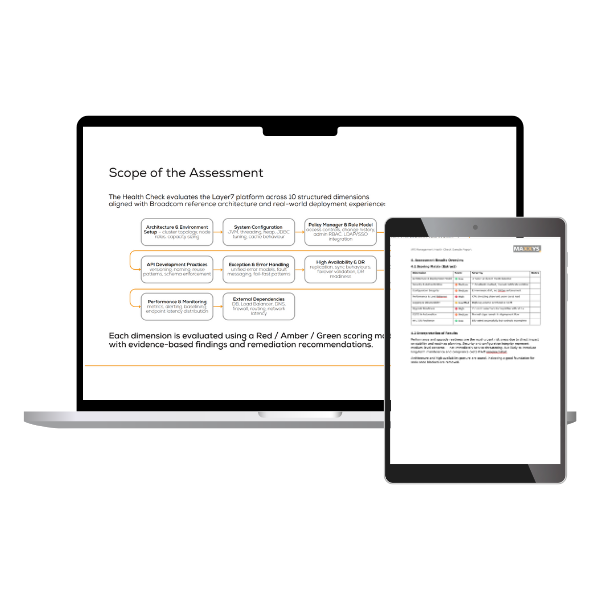
A Health Check provides a baseline for reliability, performance, security, and upgrade readiness — before a problem becomes a blocker.
HOW IT WORKS
The Health Check is executed as a structured, time-boxed 3-day technical engagement that combines architecture discovery, deep configuration analysis, and a results workshop. The delivery can be fully remote or on-site, depending on access and security policy.
Day 1 — Discovery & Data Collection
Architecture + Configuration Baseline
-
Technical workshop + export of configuration, policies, logs, and metrics
-
Environment validation (nodes, clustering, routing, LB/DNS, versions)
-
Scope confirmation + assumptions for analysis phase
- If Developer Portal is installed: baseline validation of connectivity, version, and configuration.
Day 2 — Deep Technical Analysis
Security, Performance, Governance, Upgrade Readiness
-
System-level review of config, policies, security controls, and HA design
-
Evidence-based RAG scoring + detection of drift, deprecated patterns, scale risks
-
Draft remediation priorities mapped to impact and effort
Day 3 — Findings Workshop & Roadmap
Technical Review +
Action Planning
- Walkthrough of results with platform, architecture, and security stakeholders
- Presentation of risk matrix + prioritized remediation and modernization roadmap
- Delivery of full Health Check package (PDF + optional recording)
WHAT’S INCLUDED (HIGH-LEVEL SCOPE)
The assessment focuses on five core areas that determine the long-term stability and security of an API gateway platform:
Architecture & Deployment Model
We verify whether the current gateway deployment aligns with recommended reference architecture: node roles, clustering model, environment separation (dev/test/prod), traffic routing, network placement, load balancing strategy, sizing assumptions, and HA design. The goal is to validate that the platform is built for redundancy, controlled growth, and predictable failover behavior under real operational conditions.
Security & Authentication Practices
We assess the configuration and enforcement of authentication and authorization flows, including OAuth2/OIDC patterns, key and certificate lifecycle automation, TLS/cipher configuration, JWT handling, API key rotation, threat protection assertions, and integration with IAM/IDP systems. Findings often include gaps that create exposure risk, block zero-trust adoption, or complicate audit compliance.
Configuration & Policy Consistency
We review gateway system properties, assertion structure, reusable fragments, naming and versioning conventions, deployment automation, and cross-environment parity to identify configuration drift, undocumented overrides, or legacy logic carried forward from earlier releases. This category frequently reveals maintainability issues and root causes for “it works in test but not in production” behavior.
Performance & Observability Readiness
We analyze policy execution flow, caching decisions, JDBC and connection pool settings, thread utilization, latency trends, log overhead, metric exposure, SIEM forwarding and alert thresholds. This determines whether the platform can sustain traffic growth, handle burst workloads, and support effective troubleshooting without adding unnecessary processing or storage overhead.
Upgrade / Migration / Scalability Factors
We identify technical blockers such as deprecated assertions, unsupported policy extensions, incompatible JAR dependencies, hard-coded endpoints, manual deployment processes, or undocumented customizations. The assessment provides forward-looking recommendations that reduce upgrade effort, enable automated delivery pipelines, and prepare the platform for scaling, cloud migration, or API program expansion.
Developer Portal Governance & Consumption Layer
If a Layer7 Developer Portal is deployed, we assess its alignment with the API Gateway and its readiness to support internal, partner, or external API consumers. The review includes version and connectivity validation, subscription and application creation workflows, role-based access, catalog visibility, and governance policies. The goal is to ensure that the Portal is correctly configured for controlled API onboarding, credential issuance, and usage monitoring — and that no version, configuration, or architectural gaps block future upgrades, scaling, or API program growth.
Talk to a Layer7 specialist about your environment.
Whether you need tuning, security alignment, upgrade preparation, or architectural guidance — we can help.
Developer Portal evaluation can be added if applicable to your environment.
WHAT YOU RECEIVE
- Executive Summary (technical & business impact)
- Risk Scoring Matrix (RAG format, mapped to severity)
- Prioritized Remediation Plan (quick fixes → structural improvements)
- Optional next-step recommendations (upgrade path, modernization, automation)
- Optional DevPortal findings and recommendations (if applicable)
You can preview the scoring format by downloading the Sample Assessment Report.
OUR PRICING
Fixed Engagement
3-day delivery model with a defined scope, timeline, and outcome — no open-ended consulting.
Pricing on Request
Final price confirmed after a short scoping call to match environment size and requirements.
Flexible Coverage
Available for single or multi-environment setups, including pre- or post-upgrade validation.
WHY MAXXYS?
-
Broadcom Tier-1 Partner (Layer7, Automic, DX NetOps, Enterprise Software)
-
Active delivery experience in financial, manufacturing, energy & public sector environments
-
In-house API gateway lab for validation, replication & testing
-
Vendor-independent consulting (no automatic upsell, no lock-in)
-
20+ years of enterprise integration & automation engineering
- Deep experience with Layer7 API Gateway and Developer Portal architecture, deployment, and upgrade alignment
We don’t just review API policies — we validate the entire gateway operating model including security, performance, scaling, failover, and upgrade feasibility.